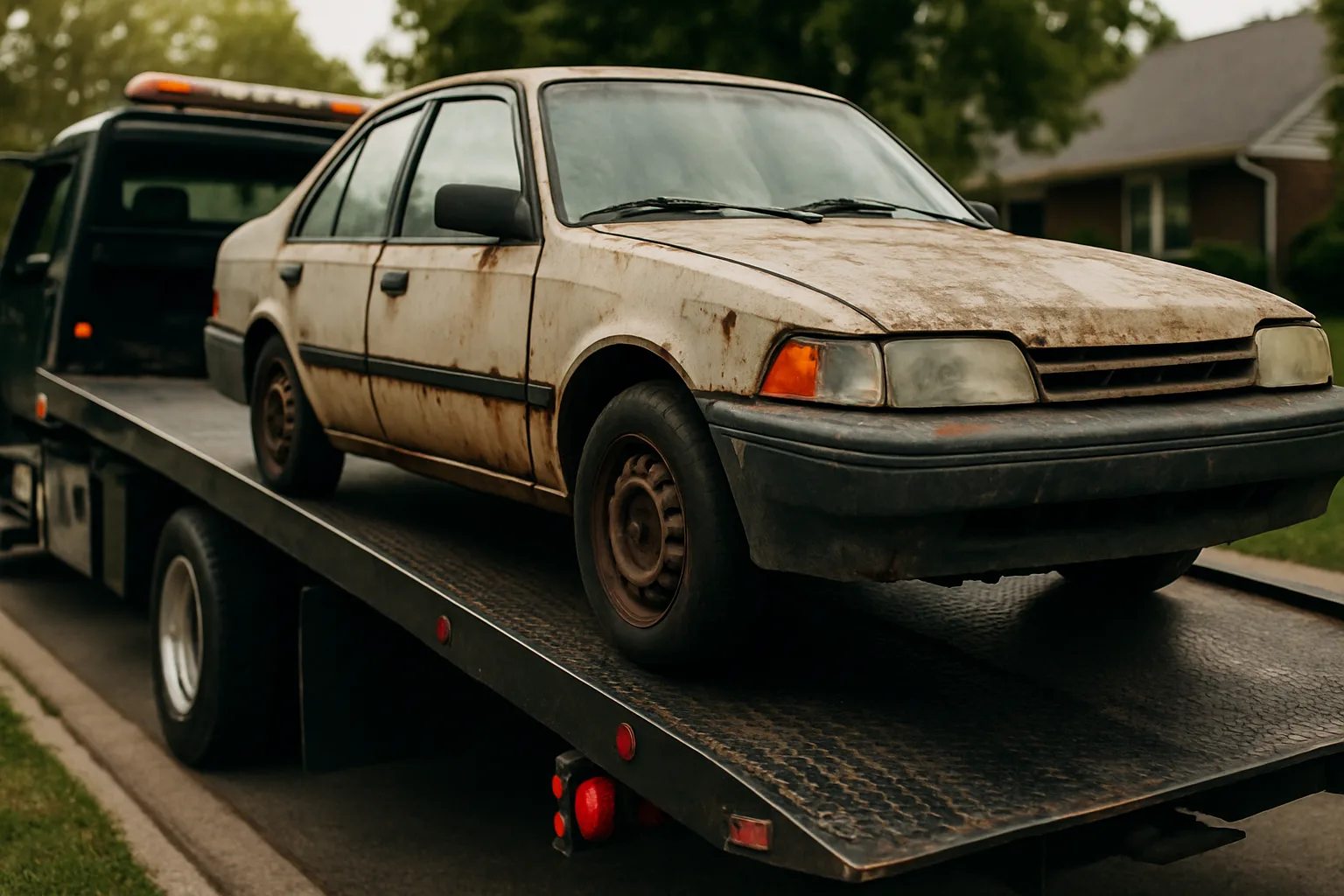
Why the Time of Year You Sell Your Junk Car Actually Matters
Most people wait until a car stops running before they think about selling it. Then they call the first buyer they find and take whatever number gets thrown at them. Here's what that approach costs you: seasonal and weather-driven price swings can move scrap car values by a meaningful margin — and most sellers never see it coming.
If you're trying to sell my junk car Gary, understanding how weather and season affect your car's scrap value isn't just interesting trivia. It's money on the table. The scrap metal market doesn't run on a flat line. Steel prices shift. Buyer demand cycles up and down. Even heavy snowfall in the Midwest can change what a buyer will pay for your vehicle this week versus next month.
Let's break down what's actually driving those fluctuations — and how to use that knowledge to get a better deal.
How Scrap Metal Markets Move With the Seasons
The price you get when you sell your car for cash in the USA is directly tied to the underlying scrap metal market. And that market doesn't sit still. Steel, aluminum, copper, and other materials recovered from end-of-life vehicles follow commodity cycles that track manufacturing demand, global trade flows, and seasonal production patterns.
Spring and early summer typically see an uptick in industrial activity. Construction ramps up. Auto manufacturers push production. Steel mills increase throughput. That rising demand tends to lift scrap prices — which means the ferrous and non-ferrous metals stripped from your old car are worth more at the yard. If you're in Gary or anywhere across northern Indiana, you're sitting close to some of the heaviest steel-producing infrastructure in North America. Local yards feel those market shifts quickly.
Late fall and winter tend to soften prices. Mills slow down. Construction stops. Cold weather reduces the volume of scrap moving through the supply chain. That compressed demand can pull scrap values down, which flows directly into what buyers offer for whole vehicles.
Key seasonal patterns to understand:
- Spring (March–May): Demand picks up. Mills restock. Often the strongest pricing window for scrap cars.
- Summer (June–August): Prices hold steady to slightly elevated. High volume season for sellers.
- Fall (September–November): Mixed signals. Early fall can still be strong, but October often marks the beginning of a price softening.
- Winter (December–February): Typically the weakest pricing period. Fewer buyers active. Logistics slow down due to weather.
None of this is guaranteed. A tariff change, a major plant closure, or a spike in global steel demand can flip these patterns fast. But the seasonal baseline is real, and ignoring it is leaving money on the table.
Weather Disruptions and Their Direct Impact on Scrap Car Value
Beyond the seasonal cycle, specific weather events create short-term price volatility that savvy sellers can either benefit from or get caught by. Gary's location in northwest Indiana puts it square in the path of Great Lakes weather systems — lake-effect snow, freeze-thaw cycles, and spring flooding are annual realities here. Each one affects the local scrap market differently.
Heavy snow and ice events temporarily slow yard operations and towing logistics. When buyers can't move vehicles efficiently, they get conservative with offers. A week of brutal winter weather can mean lower quotes simply because the operational costs of pickup and processing go up. If you're trying to sell my car fast Gary during a January deep freeze, expect some friction — not necessarily a disaster, but don't be surprised if quotes come in softer than expected.
Flooding and storm events can actually spike short-term demand for scrap cars. Flood-damaged vehicles flood (no pun intended) the market quickly. Yards get busy. But that surge in volume can also depress per-vehicle prices temporarily as supply outpaces capacity. If a major storm event hits the region, timing your sale a few weeks after — rather than immediately after — may work in your favor.
Freeze-thaw cycles accelerate vehicle deterioration. A car sitting in a yard in Gary through a Midwest winter loses structural integrity faster than one stored in a dry climate. That means if your non-running vehicle has been sitting through multiple winters, the scrap value calculation increasingly favors bulk metal weight over parts value. Get it sold before another winter season compounds the damage.
How to Check Your Car's Scrap Value Before You Call a Buyer — Sell Scrap Car in Indiana
Before anyone makes you an offer, you should have a working number in your head. Understanding how much is my car scrap value starts with a few basic inputs: vehicle weight, metal composition, current commodity prices, and condition. A typical full-size sedan weighs roughly 3,000 to 4,000 pounds. At current steel prices (which fluctuate — always check current rates before using any number as a benchmark), the raw metal recovery value forms your floor price.
But raw scrap isn't the only value driver. Catalytic converters, aluminum wheels, copper wiring, and usable engine or drivetrain components can add meaningful value above the steel floor. A car with a recent catalytic converter replacement or an intact transmission can fetch noticeably more than a stripped shell of the same make and model.
To get a free car valuation, start by knowing:
- Year, make, model, and trim level
- Current mileage and engine size
- Whether the catalytic converter is intact
- Approximate weight class (compact, midsize, SUV, truck)
- Overall condition — running, non-running, or stripped
With that information in hand, you're not guessing. You're negotiating. And when you use a platform like SMASH to put your vehicle in front of multiple vetted buyers at once, that baseline knowledge becomes leverage. More buyers competing for your car means better price discovery — not a number one buyer feels like giving you that day.
Disclaimer: Scrap metal and vehicle prices fluctuate based on commodity markets, regional demand, and vehicle condition. Always verify current rates before making selling decisions.
Free Junk Car Removal for Cash — What to Watch for Across Indiana
Free junk car removal for cash is widely available across Indiana, but the terms vary more than most sellers realize. Some buyers include free towing unconditionally. Others build towing costs into a lower offer without disclosing it upfront. A few will quote high over the phone and then revise the offer down when they arrive on-site, citing "condition issues" that were never part of the original conversation.
This is where transparency matters. When you list through a platform like SMASH, buyers compete on documented, photo-verified inventory. There's no ambiguity about what they're bidding on. That documentation — photos, condition notes, weight estimates, VIN — removes the information gap that buyers traditionally use to justify last-minute price drops.
In Gary and across northwest Indiana, local towing logistics are generally efficient. The density of yards and buyers in the region means pickup timelines are typically short. But "free towing" should always be confirmed in writing before the truck shows up. Know what the offer includes before you agree to anything.
If a buyer can't clearly explain whether towing is included, what they're paying for (whole car, metal only, parts), and when payment is made — walk away. That information gap always costs the seller. To read car selling guides that walk through what to expect at each step, bookmark resources that explain the process before you're in it.
Using a Scrap Metal Auction Platform to Maximize Your Payout
The single biggest pricing mistake most sellers make isn't bad timing. It's calling one buyer and accepting one number. The scrap car market doesn't have a fixed price. It has a range — and where you land in that range depends almost entirely on how many buyers you put in competition with each other.
A scrap metal auction platform like SMASH changes the dynamic entirely. Instead of one phone call and one number, your vehicle gets exposure to a network of vetted buyers across the region. They bid. You see the competition. The price settles where the actual market says it should — not where one buyer decided it should be that morning.
SMASH handles the documentation side too: photo verification, inventory tracking, auto-invoicing. That matters because documented loads attract more confident buyers. A buyer who can see exactly what they're getting — with photos, condition notes, and a verified VIN — doesn't need to pad a lowball offer to protect against uncertainty. That confidence flows back to you as a higher bid.
If you're ready to get competitive bids for your scrap metal, the process is straightforward. Document your vehicle, list it, let vetted buyers compete, and take the best offer. No subscription. No guesswork. No single-buyer leverage.
Whether you're selling a single non-runner in Gary or clearing out a row of vehicles from a property in Indiana, the auction model gives you data — not just a number someone made up on a Tuesday morning.
When Is the Right Time to Sell Your Junk Car?
The honest answer: the best time to sell is when the market is moving in your favor and your vehicle still has meaningful value. Waiting costs you. Every winter that passes, every season a non-running vehicle sits exposed to Midwest weather, is value bleeding out. Rust accelerates. Components degrade. The spread between scrap value and parts value narrows until you're selling metal — and only metal.
Spring remains the historically favorable window for scrap pricing. But if you've already got a vehicle sitting and it's July, don't wait until spring hoping for a windfall. The seasonal premium rarely justifies months of additional deterioration. Price your vehicle today, understand the market, and sell when the offer reflects real competition — not a single buyer's convenience.
If you're thinking about how to sell my junk car Gary and want a straightforward process without the guesswork, now is as good a time as any to find out what your vehicle is actually worth. Head to cashforcars-usa.com and get a free quote — no obligation, no pressure, just a real number based on what buyers are actually paying right now.
Frequently Asked Questions
Q: Does the time of year really affect how much I get when I sell my junk car in Gary?
Yes, it does. Scrap metal prices follow seasonal demand cycles tied to manufacturing and construction activity. Spring and early summer typically offer stronger pricing than winter months. In Gary and across Indiana, proximity to heavy industrial activity means local yards tend to reflect these market shifts fairly quickly.
Q: How do I find out how much my scrap car is worth before calling a buyer?
Start with the basics: year, make, model, approximate weight, and whether key components like the catalytic converter are intact. That gives you a floor number based on current metal prices. Always verify current commodity rates before treating any number as fixed — scrap prices move. Getting multiple bids through an auction platform gives you real market data rather than one buyer's estimate.
Q: Is free junk car removal for cash actually free, or are there hidden costs?
It depends on the buyer. Some include towing unconditionally. Others factor it into a lower offer without disclosing that upfront. Always confirm in writing that towing is included before the pickup is scheduled. If a buyer won't clearly confirm what's included in their offer, that's a red flag worth paying attention to.
Q: What's the fastest way to sell my car fast in Gary?
Have your paperwork ready: title, ID, and a clear description of the vehicle's condition. The more information you provide upfront — photos, VIN, mileage, known issues — the faster buyers can make confident offers. Platforms that connect you with multiple vetted buyers simultaneously also speed up the process significantly compared to cold-calling individual yards.
Q: Does weather damage affect what I can get when I sell a scrap car in Indiana?
Yes. Rust, freeze-thaw damage, and flood exposure all affect a vehicle's value — particularly the parts value above the raw scrap floor. A well-documented vehicle with photos showing actual condition gives buyers the information they need to bid confidently, which generally produces better offers than an undocumented, unknown-condition vehicle.
Stay up to date on scrap metal market trends and industry insights by following SMASH on LinkedIn — real market information for recyclers and sellers across North America.