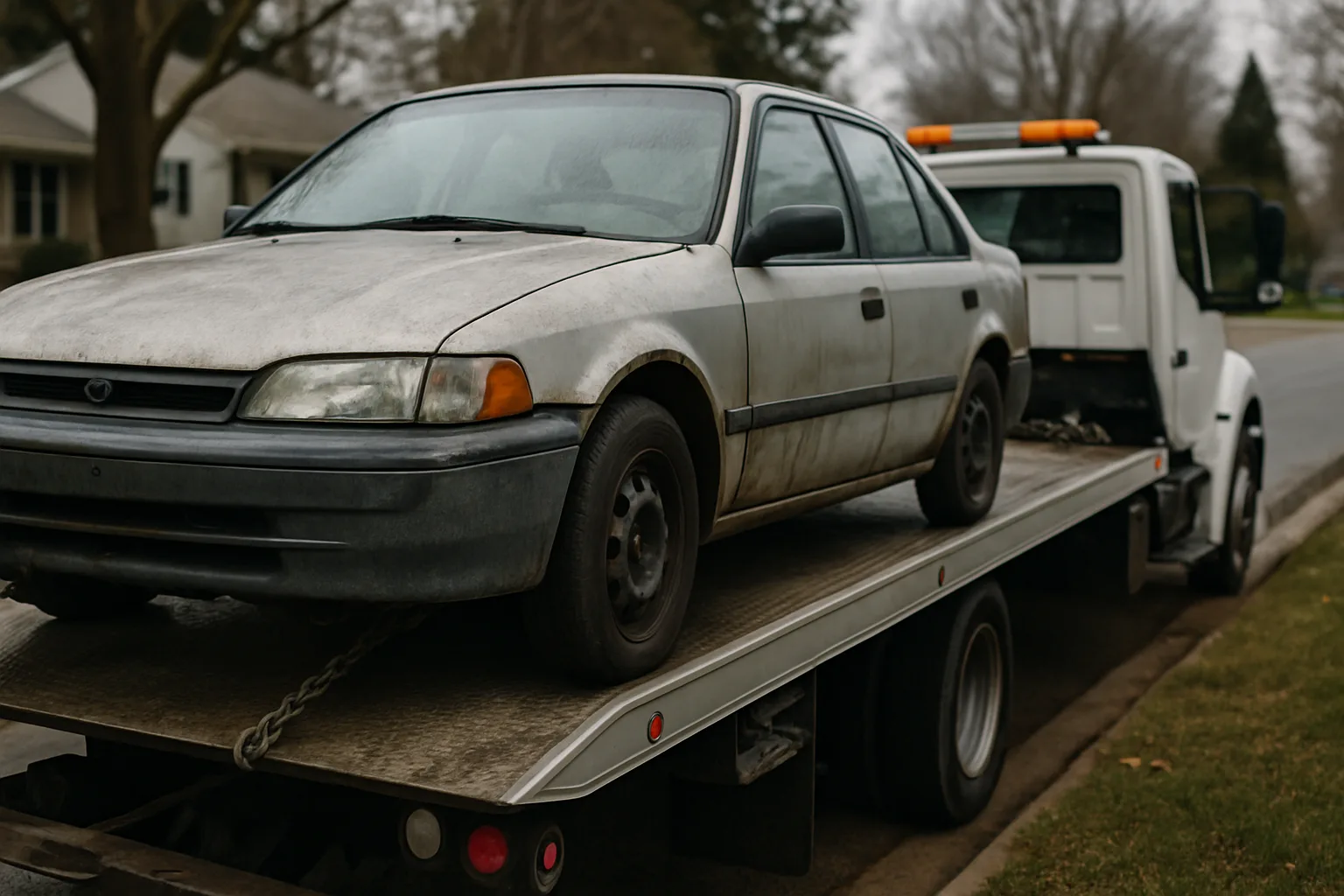
What Your Junk Car Is Actually Worth — And How to Make Sure You Get It
Most people selling a junk car leave money on the table. Not because they got unlucky — because they walked into the negotiation without knowing the numbers. Understanding scrap car value today before you make a single phone call is the difference between a fair deal and a lowball payout you'll regret by Thursday.
If you're in Lansing or anywhere across Michigan, you've got options. Junk car buyers are competitive. But they're also counting on you not knowing what your vehicle is actually worth. This guide changes that.
How Scrap Car Value Today Is Actually Calculated
Before you negotiate, you need to understand what you're negotiating. Junk car buyers aren't pulling numbers out of thin air — they're working from a formula. Once you know the formula, you can pressure-test their offer.
Your car's scrap value comes down to a few core factors:
- Curb weight: Heavier vehicles contain more steel. A full-size pickup truck or SUV will almost always outvalue a compact sedan on scrap weight alone.
- Current steel and non-ferrous metal prices: Scrap metal markets move daily. What a buyer paid out last Tuesday may not be what they're paying today. Always ask what the current metal price is — a legitimate buyer will tell you.
- Salvageable parts: If your car still has a functioning engine, transmission, catalytic converter, or intact interior components, those have resale value beyond the raw metal weight. Buyers factor this in — and so should you.
- Make, model, and year: Some vehicles have parts that are in high demand. A 2008–2016 Honda Civic, for example, has a parts market that's entirely different from a stripped-out 2003 Chevy Impala.
- Vehicle condition: Running vs. non-running, intact vs. stripped, title present vs. missing — all of these shift the offer.
You don't need a degree in metallurgy to negotiate well. You just need to know your car's approximate weight, whether it has a catalytic converter still attached, and what steel scrap is trading at roughly today. That's enough to call out a bad offer on the spot.
The Negotiation Moves That Actually Work When You Sell Scrap Car in Lansing
Negotiating with junk car buyers isn't like haggling at a car dealership. The dynamic is different. You're not fighting over sticker price — you're establishing that you know the market and won't accept an arbitrary number because it came with a confident voice on the other end of the phone.
Here's what works:
- Get at least three quotes before you commit to anyone. This is non-negotiable. When you call a second and third buyer, you're not just shopping — you're building leverage. Tell each buyer you're getting multiple quotes. It signals that you're informed and changes how aggressively they price.
- Ask specifically what their current price per ton for scrap steel is. If they dodge the question, that's a red flag. Transparent buyers can answer this directly.
- Document what's still on the car before you call. Is the catalytic converter in place? Are the tires still good? Is the battery present? Each of these has incremental value. Don't mention them casually — present them as line items.
- Don't accept the first offer if it feels low. A common tactic is to open with a low number and see if you bite. Silence and a counter are your friends. "I've had another buyer quote me higher — can you do better?" is a completely reasonable thing to say.
- Know your title situation before you call. A clean title almost always means a better offer. If you don't have one, find out your state's process for a replacement before going to market. In Michigan, a duplicate title through the Secretary of State is straightforward.
Platforms like SMASH scrap metal auction have built this kind of competitive dynamic into the actual selling process — letting vetted buyers bid against each other instead of making a single take-it-or-leave-it phone call. More competition means the market sets the price, not one buyer's margin target.
What to Watch Out For From Junk Car Buyers
Not every cash-for-cars operation runs a clean process. Some rely on seller ignorance as a business model. Here's what to watch for when you're trying to sell your car for cash in the USA:
Price drops at pickup. A buyer quotes you $400 over the phone and shows up and says "actually, the car's in worse shape than I thought — I can only do $275." This is a pressure tactic. If a buyer does this, you are 100% within your rights to walk away. Get the quote in writing via text or email before anyone shows up with a flatbed.
Refusing to break down the offer. A legitimate buyer should be able to tell you what they're paying for the scrap weight and what, if anything, they're factoring in for parts. If they can't explain the number, it's not a real number — it's a guess they made assuming you wouldn't push back.
Vague timelines. "We'll be there sometime this week" is not a pickup commitment. Pin down a date and a window. If they miss it without communication, that tells you something about how they operate.
Unlicensed buyers. In Michigan, scrap metal dealers are subject to state regulations. Ask if they're licensed. It's not a rude question — it's a basic due diligence question, and any reputable buyer will answer it without hesitation.
How SMASH Approaches Scrap Metal Transparency — And Why It Matters for Sellers
The reason most scrap car sellers don't get full value is structural, not personal. The old model — one phone call, one buyer, one number — doesn't create competition. It creates a transaction where only one side knows the market. That's not negotiation. That's just accepting someone else's math.
SMASH was built to break that model. The platform brings vetted buyers to a competitive auction format, meaning your load gets seen by multiple buyers simultaneously. The price discovery is real because the competition is real. There's no subscription fee — SMASH only earns when the seller earns.
For sellers with documented inventory — photos, weights, VIN data, serial tracking on major components — the transparency goes even further. Buyers bid with confidence when they know what they're buying. That confidence shows up in the offer. You can get a free car valuation and understand where your vehicle sits in the current market before you commit to anything.
Whether you're selling a single junk car in Lansing or you're a yard moving multiple loads a week across Michigan, the principle is the same: competition beats a single phone call every time.
Preparing Your Car to Get the Best Possible Offer
A little preparation before you go to market pays off. You don't need to spend money on a vehicle you're scrapping — but a few steps make a real difference in what buyers offer.
- Pull your VIN and run a quick history check. Know what you're selling. If the car has a clean history and no liens, that's worth saying explicitly.
- Photograph the vehicle thoroughly. Front, rear, both sides, engine bay, interior. When you have documentation, buyers can't manufacture problems at pickup to justify a price drop.
- Remove personal items and check for anything valuable. Floor mats, tools, aftermarket stereos — don't leave value in the car you're scrapping.
- Check the catalytic converter is still attached. Converters have real metal value — platinum, palladium, rhodium. If yours is still on the vehicle, that's a line item in your offer, not a bonus for the buyer.
- Locate your title. A title in hand moves the process faster and almost always means a better offer. If you've lost yours, get a replacement before you list the car.
If you want more context on how to maximize what you get before you commit to a buyer, read car selling guides that walk through the full process — from valuation to final payout.
Frequently Asked Questions
Q: How is scrap car value today different from what I'd get at a dealership trade-in?
A scrap car value is based on metal weight, current commodity prices, and salvageable parts — not retail market value. A dealer trade-in factors in resale potential. For a non-running or high-mileage vehicle, scrap value is often more realistic and faster to access than a dealership offer.
Q: What's a fair price for a junk car in Lansing, Michigan right now?
Prices vary based on vehicle weight, metal markets, and what's still on the car. Rather than citing a fixed number (which changes with the market), get three quotes from vetted buyers and compare. That spread will tell you more than any single figure. Platforms like SMASH create that competitive dynamic automatically.
Q: Does my car need to be running to get a good scrap price?
No. Non-running vehicles still have significant scrap value, particularly if the metal is intact and the catalytic converter is still attached. Running vehicles may command a slight premium if the engine and drivetrain are salvageable, but a non-runner is far from worthless.
Q: Can I sell a junk car without a title in Michigan?
Michigan does allow scrap car sales without a title in some cases, but having one almost always results in a better offer and a cleaner process. If you've lost your title, a duplicate can be obtained through the Michigan Secretary of State before you go to market.
Q: How do I know if a junk car buyer in Lansing is legitimate?
Ask if they're licensed as a scrap metal dealer in Michigan, request the quote in writing before pickup, and verify they have a physical location. Legitimate buyers will answer these questions directly. Any hesitation or pressure to skip documentation is a warning sign.
You've put time and money into that vehicle over the years. The least it owes you is a fair exit. Know your scrap car value today, document what you're selling, get multiple offers, and don't accept the first number that sounds close enough. If you're ready to move, sell your car for cash in the USA and get a free quote at cashforcars-usa.com — no pressure, no guessing, just a real number based on what your car is actually worth.
For ongoing scrap metal market insights and industry updates, follow SMASH on LinkedIn — it's where the industry pays attention.